This article was first published on The Trek on March 1, 2025.
February Training Goals and Achievements
Well, I managed to live through February! You may have read in my earlier post at the end of January, my plan was to average 15 thousand steps per day this month, plus conquer Dome Mountain every Saturday. I also planned to visit the gym for strength training weekdays. I don’t recall if this was originally part of the plan, but I decided to roll into using a weight vest on the treadmill at the gym by midmonth, and outdoors begin to use a mostly loaded pack on walks.
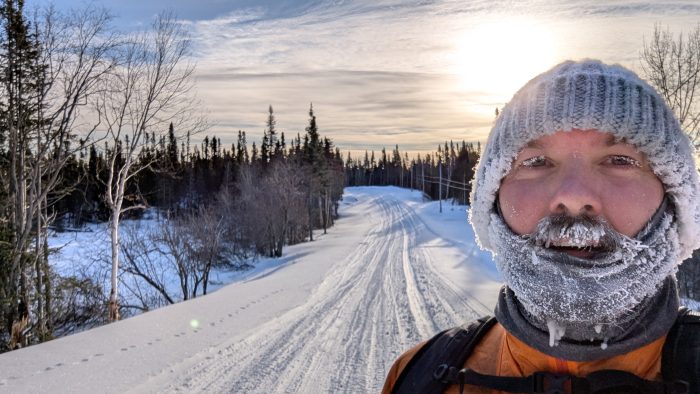
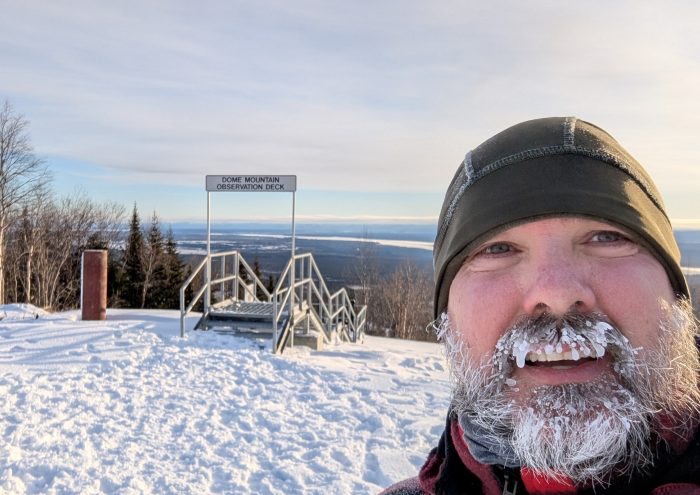
One of the frostier climbs up Dome Mountain. I’ve since shaved off the stache.
I am proud to say that I hit the 15k step goal average. My actual average for the 28 days of February was 15,811 steps each day! I will concede I did not hit 15k every day. About halfway through the month I was feeling low energy and low mood (which I know happens when I overexert and do not have enough recovery time), so I took a “zero” and only did around 2000 steps. It really helped.
Challenges on Dome Mountain and Snowy Walks
I didn’t manage to conquer the Dome every Saturday. One Saturday, after a 10-15 cm (4-6 inches) snowfall, I set out to do it, but fell short by a couple of km (1 there, 1 back) because the depth of snow and difficult footing was just exhausting. My Garmin watch was telling me I was in zone 5 most of the time, which is pretty much the hardest push I have done since last summer and the heart event. I’m not interested in hurting myself before I go, so I backed off. But I handily met my step goal that day, since the steps I was taking in the deep snow were smaller. So while I didn’t make it to the top, it was a successful workout in every other way.
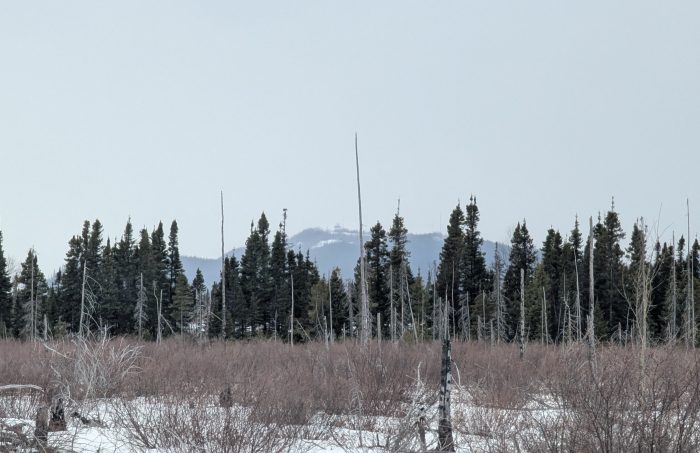
That’s Dome Mountain in the distance. You can even see the radar dome on top, hence the name.
Late in the month (the 25th) I celebrated the 4 week countdown until my departure by strapping on my pack for the first time and taking it out for a shakedown. I circumnavigated the base in just over 17 km (a little over 10 miles) on mostly packed snow and in the 20-25 lb ballpark for load. And surprisingly, I didn’t feel completely wrecked afterward!
Interesting observation: training in the snow means I was doing everything just about nonstop, which is not how I plan to hike. I want to be taking regular breaks and enjoy the journey when I am on trail, and hiking the same area over and over again in sometimes breathtaking cold is not conducive to this style of hiking. So for example, on my 17 km day, I took exactly one break: at 12 km when I stopped into a convenience store for some jerky and Doritos. I sat with the dog on the front step of the store for about 5 minutes, but I didn’t want to sit too long on cold concrete without a sitpad.
Gym, Recovery, and Mental Health Insights
But back to my goals. Attending the gym weekdays did not turn out well. I found that my mental health greatly impacted my consistency in that area. There were days I just barely managed to motivate myself to walk the dog and hit my 10k steps, let alone go to the gym. I also had 2 days per week scheduled for ankle and support muscle strengthening for prevention of injury (groin pulls, sprains etc.), but I was very unmotivated to do those because so much of my outdoor training has been on uneven snow and ice, which I believe is already meeting that need.
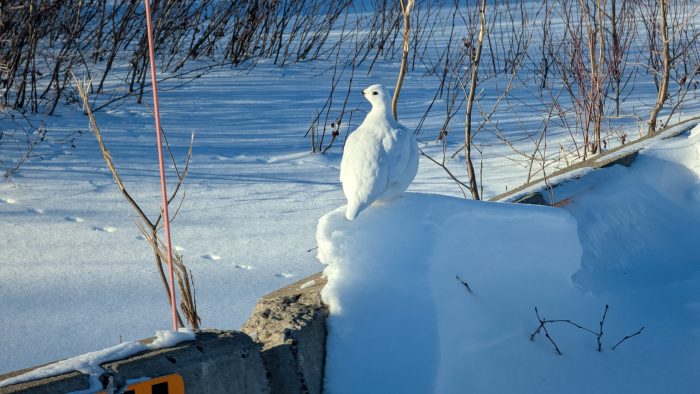
This is a Ptarmigan. Ptarmigan, meet world! I was about 6 feet away when I snapped his profile pic.
Preparing for March and the Arizona Trail
I did some research on how to acclimatize to altitude when you live at sea level, and I learned something interesting. Apparently sauna is a very good tool for this: regular sits in the sauna has been shown to increase your red blood cell count and allow you to cope with altitude quicker. Lucky for me, my gym has a sauna! So I am counting on that to help motivate me to work out at the gym more.
Looking ahead now to March, the plan is:
20 thousand steps average, from March 1 to 22;
Continue to work on consistency with the gym;
Continue to “Own the Dome” every Saturday, adding in the 2km approach, for a total of 13 km;
Cease training on the 23rd to give myself some rest and an opportunity to “heal up” before hitting the trail.
I am SOOO PUMPED to get on trail! It is almost unbearable seeing hikers already posting pictures already this year! March 26 is coming!
Watch the next video in Oliver’s Arizona Trail Series:
This article was first published on The Trek on February 14, 2025.
Why a 50-Year-Old Chaplain Chose the Arizona Trail
So what makes a 50 year old military chaplain want to burn a year’s worth of leave on one trail experience? Why leave behind wife and family, work and responsibilities to take on a long trail? I am sure there are people in my life questioning my sanity at just wanting to walk for 800 miles in a go, but there are probably some who will be asking the deeper questions. It is natural to wonder, and also very common to judge that thru hikers are shirking responsibilities, ignoring those who need them, being selfish, having a mid-life crisis (or quarter-life crisis, depending on age), there’s a million assumptions that could be made. So I will attempt an explanation.
Where to start. I am going to begin with 2022. It probably wasn’t the beginning. There are neither beginnings nor endings on the wheel of time… but it was a beginning. After three years of COVID and the challenges that go along with that, Canada was finally beginning to return to normal. And just like that, real estate prices took off. In 2022 we were slated to be posted to a new base, and we realized that most of the places I could be sent would be to inflated housing markets, which if a market correction happened, would destroy a lot of equity for us. The only alternative was to take a posting to an isolated base, where we could live in base provided housing. Goose Bay, NL was available, so I put my name forward for it and was accepted.
From Isolation and Burnout to Rediscovery
July 2022: rolling up on a more than 5000km road move with the family
The downside to such an isolated station was that I would be a one of one, and far from immediate support if things go sideways. As I mentioned, COVID had affected many, and I was feeling like I needed more human connection and support, but thought I could “tough out” three years there, especially if the community was as close-knit as I was led to believe. And certainly, that wasn’t a lie, but I probably underestimated the relational barrier that my trade presents. People make assumptions, sometimes subconsciously, and it leads to distance.
By the dead of winter, 2024, I was beginning to notice that the isolation was affecting me. I was starting to see signs in me that I had been trained to watch for in others. I was thinking possibly burnout, but my wife and I thought that an early spring hiking trip together might give me some sun, some vitamin D, and R&R to get my mind back in the game. We decided on a section hike of the AZT.
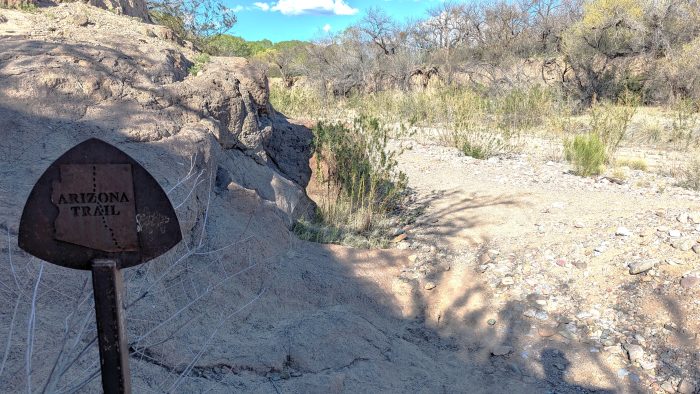
Down in a wash north of the Gabe Zimmerman Trailhead
It was a very good time from my perspective. I did come back feeling better… for a couple of weeks. But then the symptoms were back. By May I decided to throw a flag on the play as it were, and alert my supervisor that I needed some support. I was put on sick leave, but I found it very difficult to separate myself from the job when you’re the only one there doing your job, and feelings of guilt and responsibility for people continued to weigh me down.
Health Scare and the Need to Rebuild
I threw myself into running training, which I usually do in the early spring because it’s really easy to slack off in the silly season of October to December. I pushed myself perhaps too hard one day in early June, doing some very intense sprints. Did I mention I was 49? My Garmin Instinct 2 watch told me my heart rate was 200. 200? That can’t be right. I watched it as I finished up my training program and it stayed in that range for 15 minutes before normalizing. I thought, a minute or two it could just be a glitch, but that long a period, I should probably check in with my doctor.
I popped by the base medical, and saw my doctor, who referred me to the hospital for a blood test. The hospital took my blood, and then in a few minutes returned wanting to put me on monitors, and admitted me for more tests.
I had never experienced anything like this before. The sudden concern, the tests, the medications… they all had me doubting my health for the first time in my life. That evening one of the medications dropped my heart rate abnormally low, which I now believe set off my first panic attack in my life. The doctor took me off that med, but by the next day they told me that I was showing signs of having experienced a cardiac event, and they wanted me to stay on bedrest until they could move me to the provincial capital, a 2 hour plane flight away. So began a wait of over 3 weeks in the hospital, wondering if I was dying every day.
By early July they finally found me a spot on a medivac flight (I had to wait because I was stable, compared to many other cardiac patients they saw during that time). In St. John’s they gave me a dye test and a heart ultrasound, until finally concluding that no, I did not have a heart attack. But I did have a little plaque, and they kept me on Statins to resolve that.
So I returned home having been told no, I am not dying, but basically in a state where the burnout I had been feeling had now been piled on by a large dose of health anxiety. I needed to begin to rebuild myself, my confidence, my resilience, and find a new way of living that would allow me to return to the work that I loved, helping people and making a difference.
The Physical, Mental, and Spiritual Benefits of Thru-Hiking
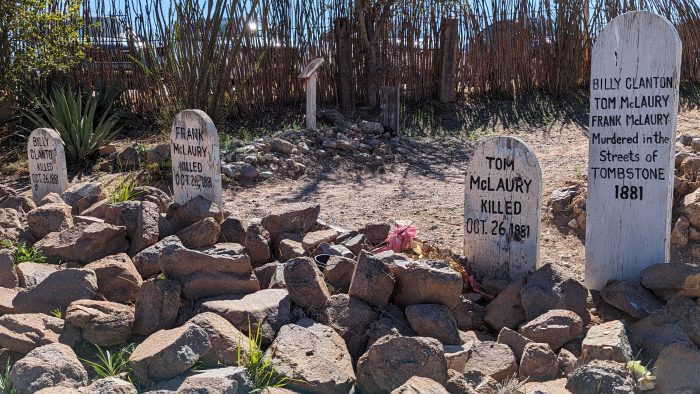
These guys didn’t thru-hike. That, and they threatened Wyatt Earp and his brothers. Neither was a healthy decision.
Over the years as my passion for hiking had grown, I had run across studies of veterans with PTSD and other disorders, experiencing wilderness adventures and even through hiking and finding themselves making real progress. For me, I believe that this thru hike can do a lot for me in terms of rebuilding myself. What will it do?
I won’t have to be responsible for anyone but myself. Eat, hike, sleep. The daily rhythm will provide stability and rest from the variable environment I have been in.
I don’t have to chaplain anyone. I don’t have to parent anyone (I have teenage and young adult sons at home). I can lay those burdens and stressors down for a time. To be fair, and I have been told by several peers, I need to be able to let go of my job, and be okay with it being someone else’s responsibility. I can make excuses about why that’s hard, but I can’t disagree.
Physical Health. Using my body all day every day, I fully expect to lose some weight.
Trust again in my Body. I also expect that overcoming the challenges of the trail will help restore my confidence in my own health, that I am not dying, that I am not fragile. It is easy to tell oneself these things, it is another to believe it deep inside after a scare like I had.
Reconnection to the Spirit. As a chaplain, my faith is not just a part of me. My sense of hope, my sense of purpose, my recognition of the parts of the person that are often overlooked or neglected by others are key to doing my job well. These things are meant to be shared, especially for people who are doing a job that deals with life and death. I have found I have been so busy serving others that I have let my own connection shallow out. I need to spend time with God – undistracted time. I have always found that easier in nature; in creation.
Trail Connections. My hope is that I do not spend the whole time alone. My hope is that I will meet fellow travellers along the trail and form new relationships – relationships that do not expect anything from me, that do not see me as “other”. And from these relationships perhaps I will carry some into the future to help sustain me after I return to work and life.
So that’s my why. A little long-winded perhaps, but I actually skipped a lot! Save some for camp chat in the evenings, I hope!
Watch the first video in Oliver’s Arizona Trail Series on YouTube:
This article was first published on The Trek on February 6, 2025 under the title Solo AZT Loadout – Kinda UL.
My Arizona Trail Gear List for 2025
Everyone loves gear lists, don’t they? I am not sure why, because it seems to me what’s in your pack is very much in the same vein as “Hike Your Own Hike” – your reasons for hiking, for speed, for zeroes, and for carrying next to nothing or the kitchen sink are your own, and probably unique to you.
But maybe that is what makes gearlists so fascinating. Because they are like a fingerprint. They identify you, where you’ve been, how you think, and probably more.
So, with that preamble, I present to you another gearlist (clicky linky for Lighterpack) running 15.9lbs Baseweight. This gearlist is by no means generic. Let me give you a run down of the big flavours.
What Makes My Arizona Trail Gear List Unique
It’s a Canadian’s Arizona Trail gear list. Despite us being America’s next door neighbour, our dollar is weaker, and whatever kind of “free trade” deal is currently in place does not touch duties and costs of cross-border shopping.
It’s a 50 year old‘s gearlist. I got me some pills to take, and a set of reading glasses, and probably some other bits and bobs that a strapping 20 year old wouldn’t even think to take.
It’s a gearlist that still has some throwback items I have had from before I ever heard of Ultralight. There’s probably a story for each of them… catch me in camp some evening and I’ll tell you a couple.
It’s a gearlist to hike the AZT. There’s a lot of stuff I am leaving at home, because it just isn’t needed. Two of them are bug spray and bear spray, just as examples. And there’s some stuff that I would only bring to the desert – the foam mattress, the stargazer kit and the groundsheet to name a few.
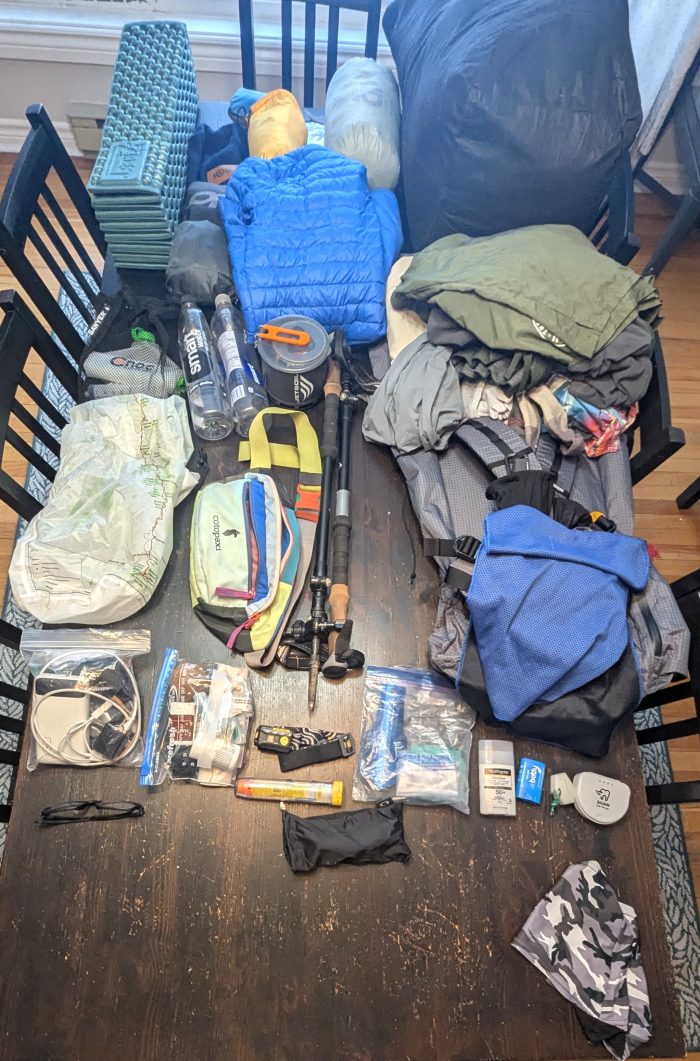
Arizona Trail gear for 2025.
The Big Four and Core Setup
Here’s a closer look at the core setup of my Arizona Trail gear list, including my shelter, sleep system, and pack. My shelter is the Durston Drop XMid 1P. That’s right, the OG. I picked it up back when I first began to hear of ultralight, and I cast my eyes around for a trekking pole tent that would not break the bank. Sadly, next to none of them were available in Canada. But at least this one was designed by a Canadian, so I ate the import duties and received my prize. Honestly, I haven’t had it out much – I picked up a 2P a year later when my wife wanted to do a section of the Great Divide Trail with me. Had to snag it second hand, they were rare as hen’s teeth at that time.
I have the stargazer kit and the new groundsheet, mainly because desert nights could be both prickly and stunning. Worth the weight penalty.
My sleep system is going to include my oldest foam mattress, an old Thermarest Z-Lite from I think about 2003. That will go in the tent on the bottom, not necessarily for extra warmth, but to protect my air mattress. On top of that will be my Nemo Tensor insulated, which is plenty of R-Value for me. I’ve had it out in sub-freezing temps and been fine on it. I have a Thermarest mattress sheet as well – a small weight penalty, but I can wash it with my laundry and it will take my sweat and body oils. I just upgraded my pillow from a Sea-to-Summit Aeros to the Aeros UL Deluxe. I found the smaller pillow to be awkward to manage, hoping the larger one works better. Lastly, I have a hand-stitched 20 degree quilt from Little Shop of Hammocks, a cottage company in Saskatchewan. I’ve actually met the owner (and craftsperson) who made it while on trail and it’s excellent work.
My pack, you can probably guess is a DurstonGear Kakwa 55. I have a Drop 40 and a Kakwa 40 as well, but I find that when I use the Kakwa 40 for extended trips, I max it out. I mean, it’s stuffed. So I decided to grab a 55 so I don’t have to spend as much time carefully organizing and compressing everything, and so that I can fit a bearcan if I have to. Not that I’m bringing one this time.
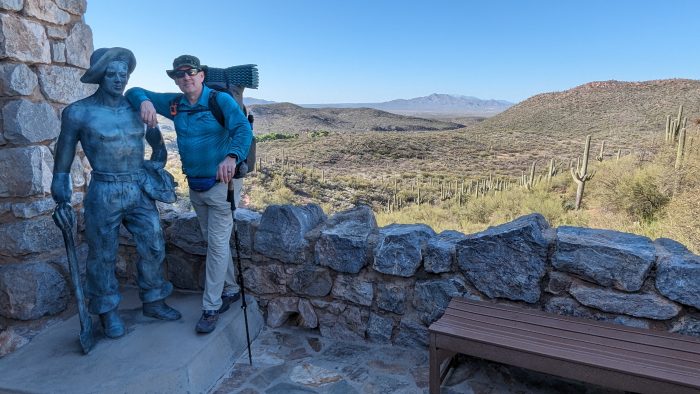
Hanging out with a statue at Colossal Caves in 2024.
Food, Water, and Clothing for the Desert
When planning my Arizona Trail gear list, I paid close attention to food, water, and clothing to survive desert conditions. I am still extremely weirded out at how nonchalant hikers are on the AZT. People eat in their tents, sleep with their food bags, and never worry about rodents or bears. It’s crazy. But, I am not going to overpack so I am just bringing a drysack with an Opsak inside for food (I think I’m going to eat outside my tent anyway, and hopefully there will be no food scents inside), and then a Sawyer Squeeze for water. I’ve used and been happy with the Katadyn BeFree on many trips, but I’ve been convinced that the rugged Squeeze will serve me better with the sketchy water sources on this trip. I also picked up a CNOC 2L bladder to complement my Smartwater bottles, which will give me a carrying capacity of 4L on the trail. I hope that’s sufficient.
For a stove, I prefer the Jetboil Stash. I have used a BRS stove, and must concede it is lighter, but the Jetboil just outperforms it in so many ways, I won’t be going back unless I am desperate. The Stash boils faster, uses less fuel, won’t overheat and collapse (Which I have literally seen a BRS do in the wild), and all for maybe a 15 gram weight penalty.
My Lighterpack only includes the clothes that will be in my pack, not the stuff I will be wearing. So, add a set of Outdoor Research Ferrosi shorts, an OR sun hoodie, a nylon belt, my Saucony trail runners (got them for a steal on clearance last year, and they are decent performers though I would prefer Hoka Speedgoats, and will probably buy them if I need a new pair on trail), a set of Injinji sock liners, a pair of Darn Tough Micro Crews, my Dirty Girl gaiters, and my Garmin Instinct 2 Solar watch. Oh, and a ball cap.
In my pack I’ll have a light half zip fleece which is my go-to midlayer 90% of the time which gets worn first for light rain, chilly mornings, chilly evenings, and any other time I need more than thin technical fabric. I’ll also have a Decathlon Forclaz hooded puffy for REALLY cold mornings and evenings (anything within spitting distance of freezing), a pair of OR Ferrosi pants, some short shorts for when I am too hot to think or want to go for a swim in Hutch’s Pool, a merino t-shirt for a backup top and extra underwear and socks. I’ll have a pair of very light merino gloves if I am desperate, but my hands usually run pretty hot.
I’m bringing raingear – OR Helium top and bottom just in case. They are very lightweight and not very durable, but if something sustained hits – especially wind and rain at the same time, I think I’ll be glad to have them. Better safe than sorry.
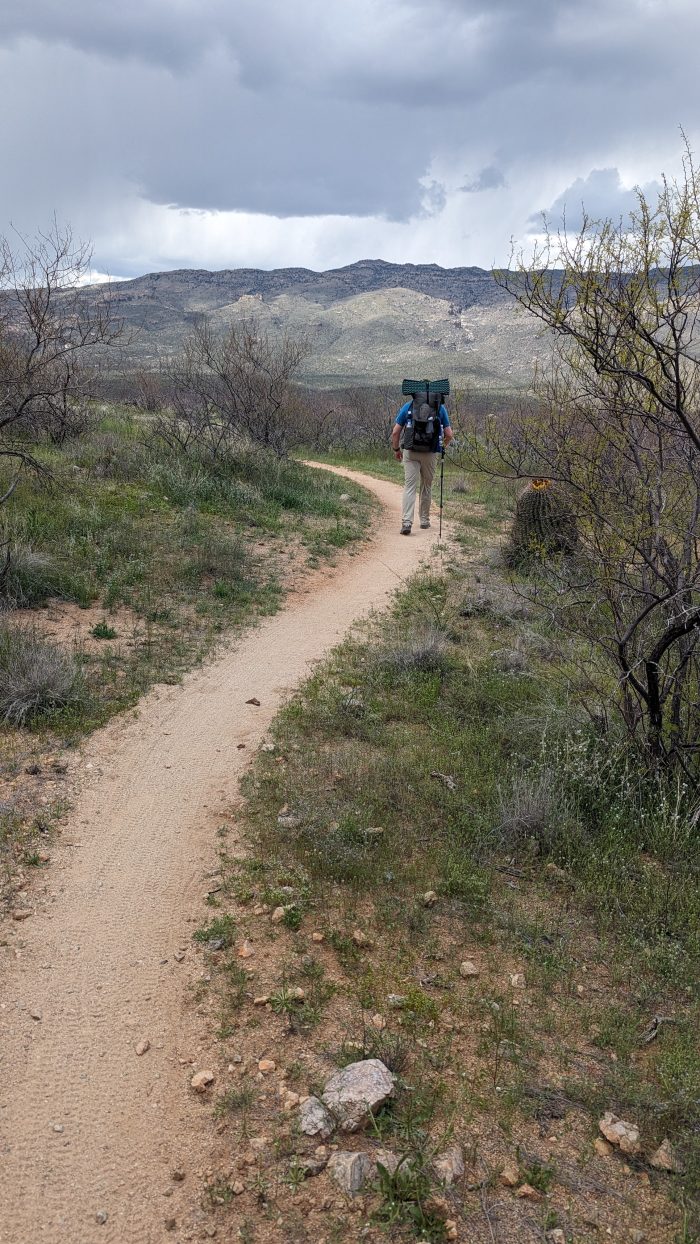
Breaking trail… an easy job on this segment! I believe this was heading into Saguaro National Park.
Electronics and Other Essentials
Finally, my Arizona Trail gear list includes electronics and a few other essentials to make desert hiking safer and more comfortable. I’ll be packing a GroPro 12, and hope to put together some trail videos. I will have a couple of attachments along with, including a headmount and a polemount. Packing a 20mAh Battery pack, and it should last as long as I need it to as I think the longest pull away from a potential recharge is 6 days. I have an extra battery for the GoPro too, so if I can avoid the need to top that up and just use the battery pack for my phone, that will be awesome.
Just a few other notables – I use a stick sunscreen – I find it less messy and chance of spilling. Got a Jereko Gear Stake/Spade driver from GearTrade in Calgary – it was handy on my last trip for driving stakes in the hard ground without resorting to smashing the stakes with rocks. Only caution – it is plastic, so if it is not used carefully it will break. I managed to get my hands on a teardrop thermometer – I like knowing how cold it really is in the microclimate. I have this handy cooling towel I got a couple of years ago at a fitness event on base – it is so light and quick drying I love bringing it. It can serve as a drying towel for a swim, a drying towel for condensation on the inside of the tent, and of course something to cool the neck on a hot day. Also packing a cork ball – I wanted something to massage feet and limbs with in case I inflame some tendons or something. You never know right?
This article was first published on The Trek on February 2, 2025.
Getting Back Into Shape Before the Arizona Trail
It is super true what they say about how people my age feel like they are 20 inside… until they do something physical with a 20 year old… then they KNOW they are no longer 20! That’s definitely the thru-hiker world! Lots of 20 somethings on the trail, mountain goating, hiking into the night, up at the crack of dawn, and drinking their faces off in every trail town. I won’t be one of them.
Dawn half marathon training run by the shores of Cold Lake, April 2021
Staying in shape has been a challenge to me at the best of times – if I am honest, I prioritized my kids over my own health for much of the last 20 years. Thankfully, back in 2010 I began to focus on my cardio, and started doing running training for 5, then 10k, then half marathons. But every year it was the same – start whipping myself into shape from January, get to the summer, take advantage of a reasonable amount of fitness until September then give it all up and become a slug until January again. And when I say a reasonable amount of fitness, I mean lose about 10 pounds but still be a good 20 lbs overweight.
However, I am the kind of person that works well with a goal. A thru-hike will be the most physically demanding thing I have ever done over 45-50 days in my life… outside of basic training (which I did at the tender age of 40 by the way…)! With my eyes on a flight date, March 25 2025, I am determined to prepare more carefully for this than for pretty much anything else I have ever done – including the half marathons I have run!
Building a Training Plan for the Arizona Trail
Now, I do have one advantage over many prospective thru-hikers. Because I am in the military, we have fitness instructors to consult, and they have helped me customize something to prepare me for the rigors of the trail. They have me doing a bunch of strengthening exercises for those small muscles in my lower body that get taxed on irregular ground like trails, for stability and to keep my footing. The last thing I want is a twisted ankle or knee to take me off trail!
For my big muscles, I have decided to focus on just increasing my walking, and as I get closer to the start I will be adding in a weight vest to simulate the backpack. I don’t want to use my actual backpack because where I live the temperature varies from 32F down to -30F. I don’t want to risk a plastic buckle cracking in the cold or the fabric of the pack getting compromised because of the cold, or any of the gear I throw inside for ballast.
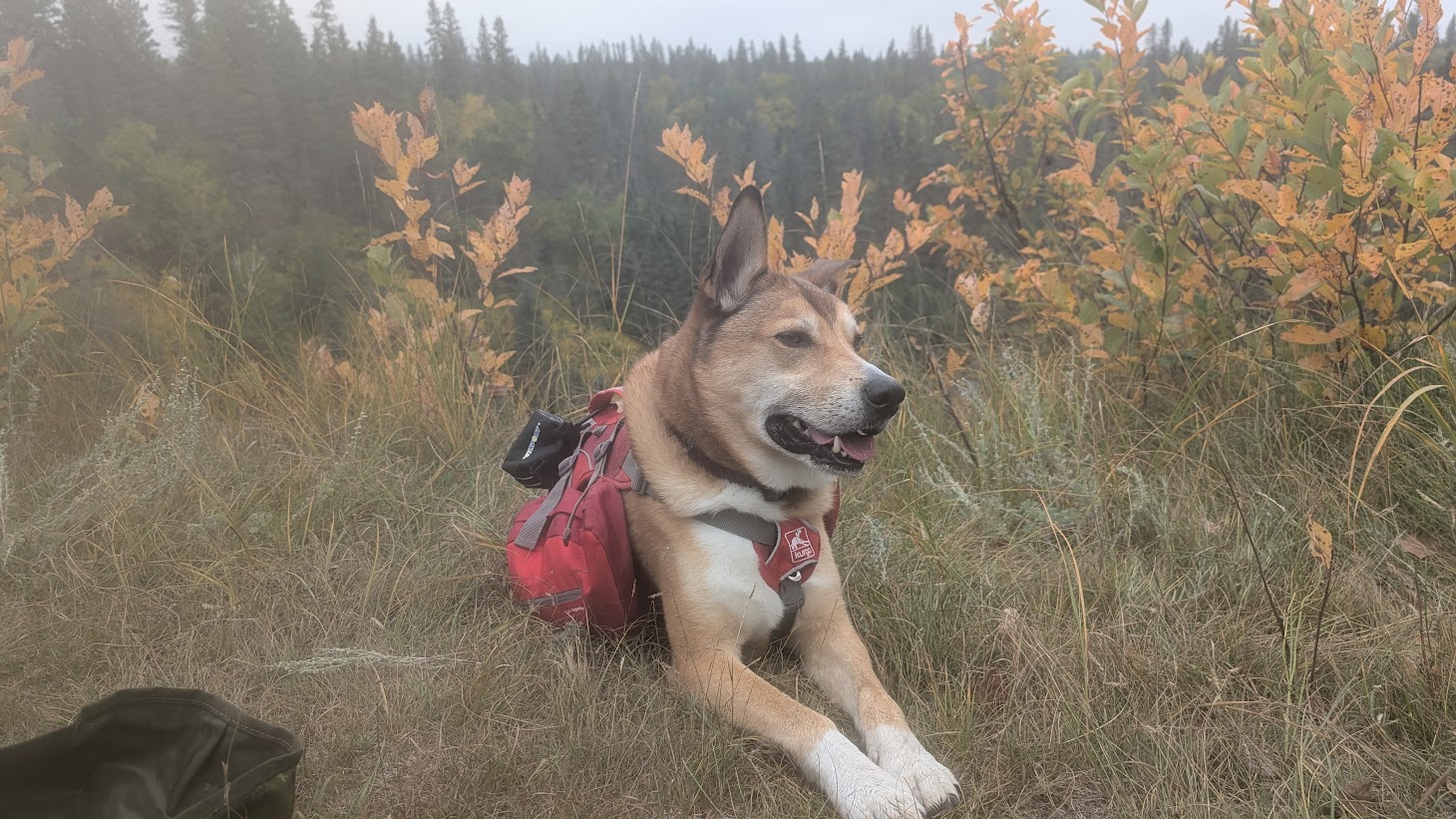
Who’s a handsome boy? Watson, that’s who!
In January I planned to walk a minimum of 10 thousand steps per day. That will be a little over an hour a day of walking. I have a trusty sidekick to motivate me named Watson, and he doesn’t care how cold it is either – he has a double coat and is happy as a clam in any weather. Come February I plan to ramp up to a floor of 15 thousand steps per day, which should be about an hour and a half of walking per day. Then in March, I’ll move up the floor to 20 thousand steps per day which will definitely require more than 2 hours per day walking. I hope by then the sunrise will be earlier and I’ll be able to get most of those steps in before the kids go to school so it doesn’t take over my day.
Training for the Arizona Trail in the Canadian Winter
Depending on the amount of snow we get I may shift over to snowshoeing. If I do, my total steps expectation will drop but my time goal will remain the same – snowshoeing is definitely higher intensity than walking! Preparing for a thru hike outdoors in the dead of winter is definitely giving me an excuse to put to use everything I know about layering and frostbite protection. Not to mention teaching me about perseverance!
And the last element will be getting some vertical in. Most of my local walking trails are fairly flat, but one: Dome Mountain! The site of an old radar station, if I hike up the access road to the top it’s about 6 miles return, with a gain of about 850 feet. I hope to start doing that once a week, moving to a double go in March (up, down, then up and down again) once a week. My hope is with all of this prep, the trail won’t be quite as shocking as if I went in cold… I’ll already be going in “cold”, but cold and unprepared? I plan to be ready for 15-20 mile days once I reach Patagonia, and to be pushing 25s when I reach the vicinity of Pine. If I can do that or better I will finish on time!
January Training Results
So, how did I do in January? Seeing as how it ended just a few days ago…
The beginning of January I took a week or so to work on healthy relationships, taking a flight out to see my family and old friends out west. Unfortunately, that trip proved disruptive to my goals – I only met that step goal twice in those 9 days.
It’s chilly at the top of Dome Mountain.
On the bright side though, on my return, my trusty sidekick Watson and I built some solid pattern in January the rest of the time! My average steps per day over the month was in excess of 10 thousand, in spite of the lull. And we did Dome Mountain three times. The last time we added in an extra mile and a half before and after, doing about 8 or 9 miles along with the elevation profile. The snow on the road was fairly even due to snowmobile traffic, and the fact we haven’t had any major dumps of fresh snow.
I have also been able to add in some work at the gym, working on strength and stability of feet, ankles and knees, as well as some “Jacob’s Ladder” and the stairclimbing machine. The treadmills have been helpful, as they have variable inclines, so I can get some more glute work in.
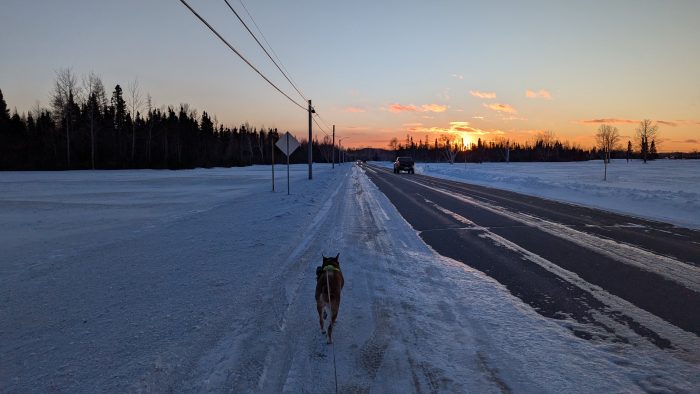
No sidewalks in the winter, only roadwalking…
The best part of all of this additional training is it has fit into less than 2 hours per day. I typically do an hour in the morning, just after the kids go to school, and an hour after they return. With the late sunrise (around 8am) and early sunset (around 4pm) this is safest, so I don’t have to worry about reflective vests. We don’t have plowed trails, so all our walking is on roads!
It hasn’t all been wine and roses. I have been watching carefully for signs of wear – blisters, chafing, etc. I have had some achiness on the back of my right heel, but it seems to have largely resolved itself. I have also had what feels like a puffy spot on the ball of my left foot, that gets a little achey and sensitive, but when I walk on it, there is no pain. I thought it might just be some inflammation, so after my big push up Dome early last Saturday morning, I resolved to take “36 hours” off. I put off my 10k steps on Sunday until the evening, giving me all day Saturday, all night, then all day Sunday as rest. It seems to have worked and I kept up my streak!
Lessons Learned and Motivation for Fellow Hikers
As the days get longer I plan to move my morning hour to before the kids go to school and more into the supper hours, to leave more time with family. I hope that this is an encouragement to anyone who is trying to figure out how to make time to train for a thru-hike whilst still doing “normal” life. You can do it!
More From This Series
Preparing for an Arizona Trail (AZT) Thru-Hike at 50 – January Results (You’re here)
We were very pleased by how quiet the teenagers were that we shared the campground with. After retreating to our tents for the night, they stayed by the fire with their chaperones and cleaned up after a late dinner. The only issue was the water pump. We were camped near it, and in order for them to clean up, they had to pump it. It was noisy, but Cheryl had a solution: earplugs. With them in, she had no complaints. The teenagers kept their voices down when walking past our tents and took care of their evening responsibilities.
I cannot say the same about the mouse that decided to visit Cheryl’s tent that night. With her earplugs out, she woke to the sound of something hitting the tent. Watson lifted his head, alert but calm. A dog not growling is a good sign, so there was no need to worry. Still, seeing bear scat just a few feet from our tent reminded us that wildlife was nearby, even if the scat was a few days old.
Cheryl lay there a while, listening to the mouse climb a guyline, fall, hit the side of the tent, and slide down to the grass. Watson followed its movements with his eyes. The mouse seemed to prefer the empty side of the tent rather than the vestibule with her backpack. She was not interested in finding a hole chewed into the bag or straps destroyed.
Once Cheryl reassured Watson everything was fine, they ignored the mouse and fell back asleep. By morning, it was gone, leaving no damage behind.
Day 2: Cabin 3 to Cabin 4 Jackfish Lake via Newfoundland Loop
Leaving Cabin 3 on the Newfoundland Loop
Epinette Creek Trail is well signed, and with the mowed grass, you will not get lost. There is a sign to the Newfoundland Loop by the cabin showing the distance if you follow the north or south sections. We chose the longer north route on Day 2 because our plan was to hike from Jackfish Lake to the trailhead on Day 3. Shortening the distance on the final day, which would have been over 20 km, seemed like a wise decision.
We packed up while the campground was starting to stir and learned about a shortcut to the trail behind the picnic tables on the hill near the water pump. Rather than walk by another tent with a dog, we took the shortcut. We were quickly on the trail and began the north loop.
North on the Newfoundland Loop
One thing you notice about the Epinette Creek Trail is the signage. There is a “Do Not Enter” sign in one direction and a distance marker in the other. This is because the trails are also used in winter, and the directional signs help prevent collisions and keep trails in good condition. We happened to be going in the same direction as the signs, so we continued without issue. If you were trying to follow the south route, the signage could be a little confusing.
The trail was as wide and well-groomed as the previous loops. To our right, there was a large open area where we could see the south loop before the trails eventually separated.
We had been told about a hill with rocks on the north side, and they were right. The rocks were smooth stones, not jagged rocks embedded in dirt. It seemed as though a truck had dumped the rocks to make a road accessible for maintenance vehicles. The ground in this area was sandy, which would make it challenging for vehicles if the trail was wet.
The trail crossed a few dirt backcountry roads that saw little use. We were unsure if these were quad trails or maintenance roads. We stayed on the groomed trail, keeping straight unless a sign directed otherwise.
There are a few short hills on the Newfoundland Loop.
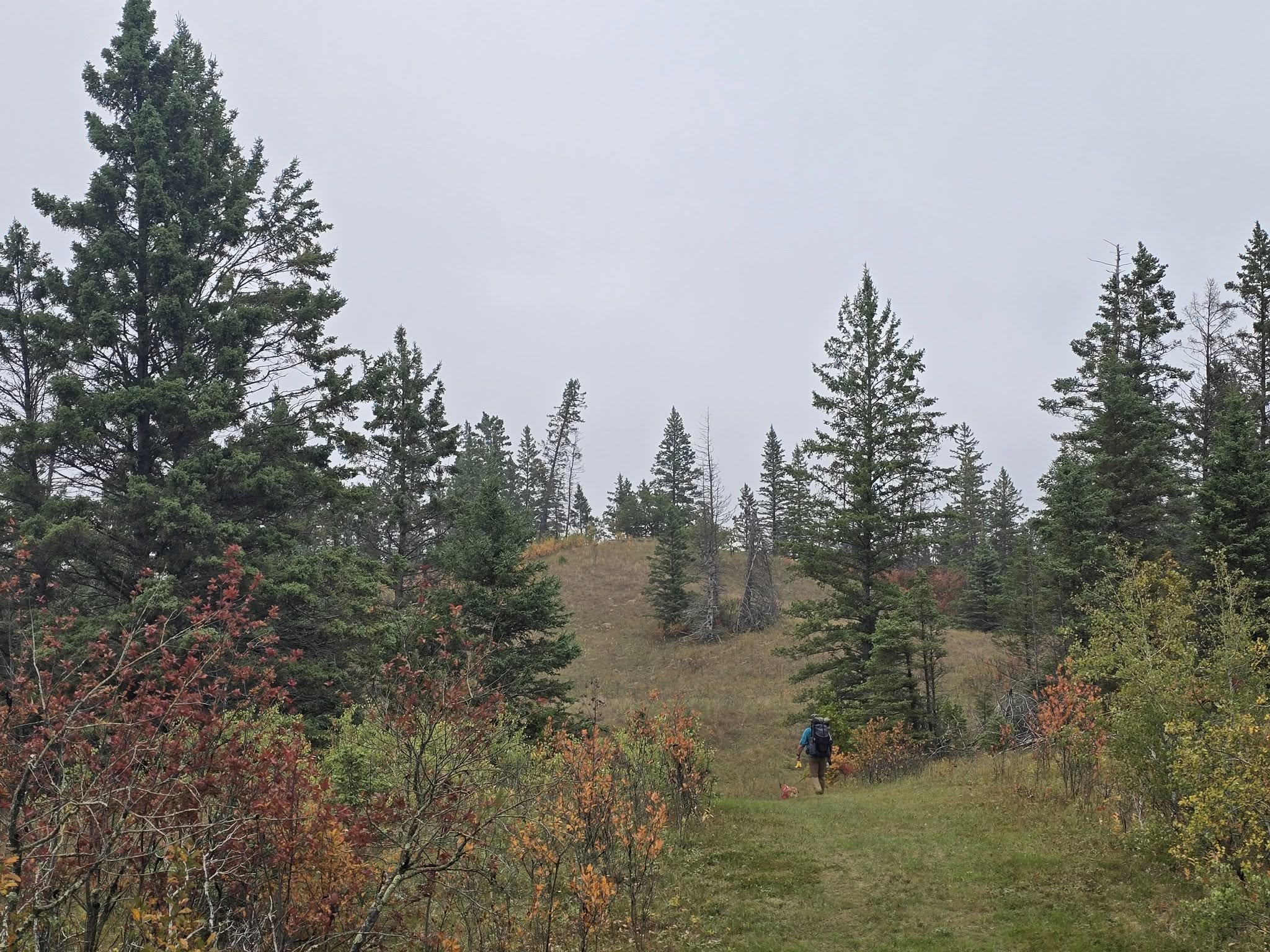
The Newfoundland Loop had more rolling hills than the other loops. The scenery changed frequently, sometimes reminding us of the Thompson Valley in British Columbia with grasses and unusual trees, then shifting to aspen forests or spruce-lined paths. There was always something new to look at, and the fall colors were bright.
A Short Break
Although our Garmin watches later reported otherwise, it became very hot at one point, so we took a break in the shade for lunch. Watson had water from his collapsible bowl and a small meal from his pack. There are no water sources along this section of the trail. Previously, we had crossed the beaver dam creek, and the cabins with their water pumps were relatively close.
Covering approximately 13.5 km with a dog and limited water meant we had to be mindful of consumption to make sure Watson had enough. We decided to carry extra for the hike out to ensure neither of us needed to ration.
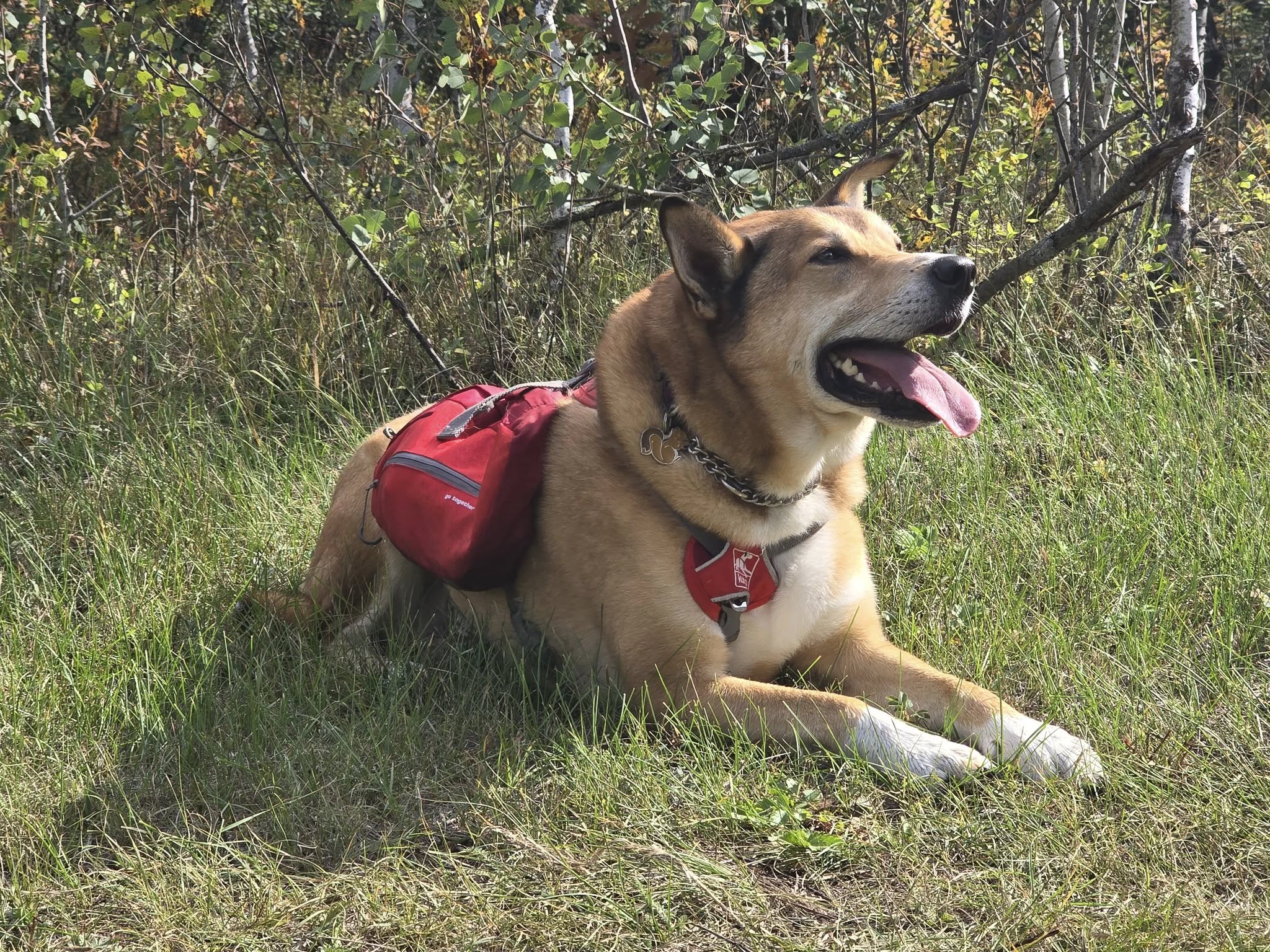
Watson having a well-deserved rest.
We strongly advise hikers with dogs to pack plenty of water for the Newfoundland Loop when hiking in warmer temperatures. Your dog will thank you.
Hiking Apart on the Newfoundland Loop
This hike was also an opportunity for Cheryl to do a semi-solo hike. We brought radios to communicate, and for the final six kilometers, Cheryl hiked alone while Oliver stayed behind with Watson. This gave her the chance to get comfortable hiking a good distance apart from the group.
A couple of grouse tried to derail the plans, hiding in the brush beside the trail until Cheryl was very close. Just as she passed, they would suddenly explode into flight. The sound of their wings is startling at first because it mimics a larger animal charging through the forest, which is an effective deterrent for predators. It can make a hiker jump if you are not expecting it, especially in a quiet forest when you think you might have disturbed a bear. After an initial scare, Cheryl quickly realized it was just a grouse and continued on.
This happened multiple times along the trail. Each time, the grouse would wait silently in the underbrush and then take off at the last moment. Cheryl found it both amusing and slightly frustrating as she had to pause each time and shout at the noise, before recognizing its source.
Other than the grouse, the hike alone was uneventful. Despite the brief surprises, the trail remained peaceful, and the semi-solo hike gave her confidence in hiking independently while staying in touch over the radio.
Arriving at Cabin 4
The final approach to Cabin 4 included a gate to prevent vehicles and a stone-covered hill descending toward the last kilometer. The path led to an open area with picnic tables, and to the left were cabin amenities, including an outhouse, water pump, and firepits.
As the first to arrive, we pitched our tents under trees, which was ideal. There could have easily been space for a third tent. The campground had plenty of room, so anyone arriving later would have had a spot to pitch a tent.
We enjoyed a relaxing afternoon after the longer hike, hydrating and resting. After dinner, we put our bear canisters in the cabin like at Cabin 3. With chores done, we could relax until bedtime. Watson had a good snooze on the ground, cooling himself before other hikers arrived.
Evening in Camp
Oliver started a campfire in the firepit, and we had a great evening connecting with the other hikers. Conversation ranged from hiking trails to gear choices, and it was enjoyable to share experiences. Two additional hiking parties had chosen the Epinette Creek Trail because the Mantario Trail was closed due to the summer forest fires. We enjoyed hearing about the Mantario Trail from those who had hiked it before and learned what to expect when it reopens.
The discussion shifted to gear. We compared Durston tents, including two we had and one from another hiking party that was brand new. Chair comfort and weight were debated, and we discussed hiking quilts versus sleeping bags. Tarp tents and water-carrying strategies all came up. It was helpful to hear the perspectives of others and see what gear choices worked best for different hiking styles.
The rain, which had lightly sprinkled over dinner, eventually increased, ending our campfire conversation for the night. Everyone retreated to their tents, but it was still rewarding to be part of a small community of hikers. Sharing stories, learning tips, and swapping experiences made the evening a memorable part of the hike.
Newfoundland Loop Conditions and Scenery
This section of the trail is approximately 13.5 km. Although signage may read 11.7 km, the distance is longer from Cabin 3 because of the connector trail to the loop split. You will see a sign indicating about 2 km left when your Garmin shows 11.7 km. Be prepared for slightly longer mileage.
As mentioned, there are no water sources after leaving Cabin 3 until Cabin 4. Carry enough water on hot days, as there are no streams or creeks along this section.
This section has more rolling hills than other loops. Besides the stone-covered hill after Cabin 3, the hills are gentle but consistent. Uneven areas come from clumpy grass, cleared downfall, or tracks left by maintenance vehicles. The trail is mostly hazard-free.
While Epinette Creek Trail does not offer sweeping vistas, the prairies and colorful fall leaves create a beautiful scene. The trail passes through different landscapes, from tree tunnels to open fields, with mushrooms and flowers scattered along the way.
Cabin Amenities and Tips
Water: The pump at Cabin 4 was not as noisy as Cabin 3. We’d still recommend getting water the evening before to minimize the impact on others.
Outhouses: There was hand sanitizer at Cabin 4’s outhouse and there was less odour, most likely because this outhouse saw less use than the others due to the distance.
Firewood: There was still lots of firewood at Cabin 4 in September.
Final Thoughts on Epinette Creek Trail – Day 2
Day 2 on the Epinette Creek Trail had more hills than Day 1. The distance between cabins was longer, which meant we needed to carry enough water to last until reaching Cabin 4.
Even though we were hiking a longer distance on Day 2, the trail was easy, and we arrived at camp early. This gave us a relaxing afternoon to sit back and do nothing. While Jackfish Lake is accessible, it is not really a swimming lake. You might wade in it, but it is more like a pond than a lake.
Since Cabin 4 is not used as much, the campsite felt cleaner than Cabins 2 and 3. The outhouse was less full and had the bonus of a working hand sanitizer dispenser. We were also happy to see the bear-proof garbage and recycling bins still available 20 km into a backcountry trail. We made sure to dump our garbage again before settling in.
Cabin 4 is the furthest point you can reach on the Epinette Creek Trail before starting the south loop back toward Cabin 3. One of the hikers that day went all the way from the trailhead to Cabin 4, covering 20 km, and planned to hike out the next morning. If you prefer shorter hikes, you can stop at the cabins along the way or on the return trip instead of doing the full distance. We covered 20 km on Day 3, but that is a story for the next blog.
Day 2 Summary
Date: September 13, 2025
Distance: Cabin 3 to Cabin 4 (Jackfish Lake) – ~13.7 km / 8.5 mi
Elevation: 614 ft
Amenities:
Cabin 4: Pit toilet, warming cabin with wood stove, water pump, firepits, picnic tables, bear-proof garbage and recycling bins
Water Sources: Only available at cabin water pumps.
Wildlife: Deer tracks and plentiful bear scat. Coyotes yapping in the evening.
Navigation: Wide, mowed trail with clear signage to the next cabin. Don’t turn on the roads that you cross.
Best Time to Hike: Spring (before ticks) or fall (after ticks)
The Epinette Creek Trail is located in Spruce Woods Provincial Park, about 180 km from Winnipeg, Manitoba. The trail system consists of four connected loops that together create a total return distance of 41.7 km. These moderate trails—Spruce, Juniper, Tamarack, and Newfoundland—take hikers through prairie grasses, mixed forests, and rolling sandy hills.
The Epinette Creek Trail is a multi-use trail with year-round traffic, permitting hiking, biking, and winter activities. The backcountry campsites include cabins equipped with wood stoves. These are most often used in winter, as mice tend to be active during the summer months. Cabins are generally intended for emergency shelter, except for Jackfish Lake cabin, which can be reserved. One of the perks of the Epinette Creek Trail is that you don’t need reservations. When we hiked in 2025, park entry fees were waived until March 31, 2026, making it an especially budget-friendly adventure.
After moving from Labrador to Manitoba this summer, we were eager to find a short weekend hike to scratch the itch of getting outdoors. Google suggested a few options, but the Epinette Creek Trail stood out because it allowed us the flexibility to shorten our trip if needed.
While Oliver had hiked the Arizona Trail earlier in the year, Cheryl was just coming out the other side of medical roadblocks and hadn’t been on a hike since her diagnosis. This would be her first strenuous exercise, and we weren’t sure if her body would be as willing as her mind. We needed a trail that would let us opt out of sections if necessary, but still continue if things went well. It also had to not be too challenging, since we didn’t know how much would be too much. The Epinette Creek Trail turned out to be the right choice for our circumstances. On September 12, 2025, we set out from Winnipeg with our dog, Watson, to explore Spruce Woods Provincial Park.
Day 1: Epinette Creek Trail Trailhead to Cabin 3
Driving to Spruce Woods Provincial Park
We began our drive from Winnipeg after Cheryl’s specialist appointment that morning. The drive was uneventful as we made our way west past Portage la Prairie and into Austin, where we stopped at Subway for a quick bite to eat. We then turned south toward Carberry before finally reaching Spruce Woods Provincial Park.
Our first stop was the Friends of Spruce Woods Provincial Park Gift Shop, where we looked for additional information about the route before hitting the trail. The gift shop hours do change, so check their calendar for the dates and times they are open. The Visitor Centre was already closed for the season, so it was a very short visit. We then went back up the road to the turnoff for Epinette Creek Trail. The signs off the main road are well marked with large wooden signs to direct you where to go.
Trailhead and Parking
The road in passes through an open grassy field before you arrive at a dirt parking lot. Here you’ll find the access points for Epinette Creek Trail and a portion of the Trans Canada Trail, which eventually leads to the Yellow Quill Trails. There were a few cars already in the parking lot, but we weren’t concerned about space since there was plenty for everyone. If you aren’t in a rush to start hiking, you can wander around and read the interpretive signs in the area.
Cabin 1 is located right at the parking lot. If you arrive extremely late and don’t want to hike in the dark, I could see why you might camp here. It would be most appropriate in the winter months, when it’s ideal for staging cross-country ski trips, warming up while switching into winter gear, or waiting for friends to arrive.
Hiking to Cabin 2 (1.5 km)
The first trail sign for the Epinette Creek Trail is beside Cabin 1. You’ll have no difficulty spotting the trail—it’s a wide, two-track path that has been worn from use and frequently mowed. The ground was quite level as well, which meant we could walk without worrying about twisting an ankle or tripping on roots. We had wondered if the trail would eventually narrow, but it stayed this wide for all four loops.
Approximately 1.5 km from the parking lot is Cabin 2. The hike in is an easy stroll through open grassy plains before leading into the trees, where the cabin is tucked down a hill. There is adequate signage to find your way, and the trail leads straight to the entrance. At Cabin 2 you’ll find a hand pump, a firepit surrounded by benches, picnic tables, garbage and recycling bins, and an outhouse. Inside, there’s a logbook to sign.
We had heard from other hikers who camped there that mice were active in the evening, so they preferred to pitch their tents outside instead of sleeping in the cabin.
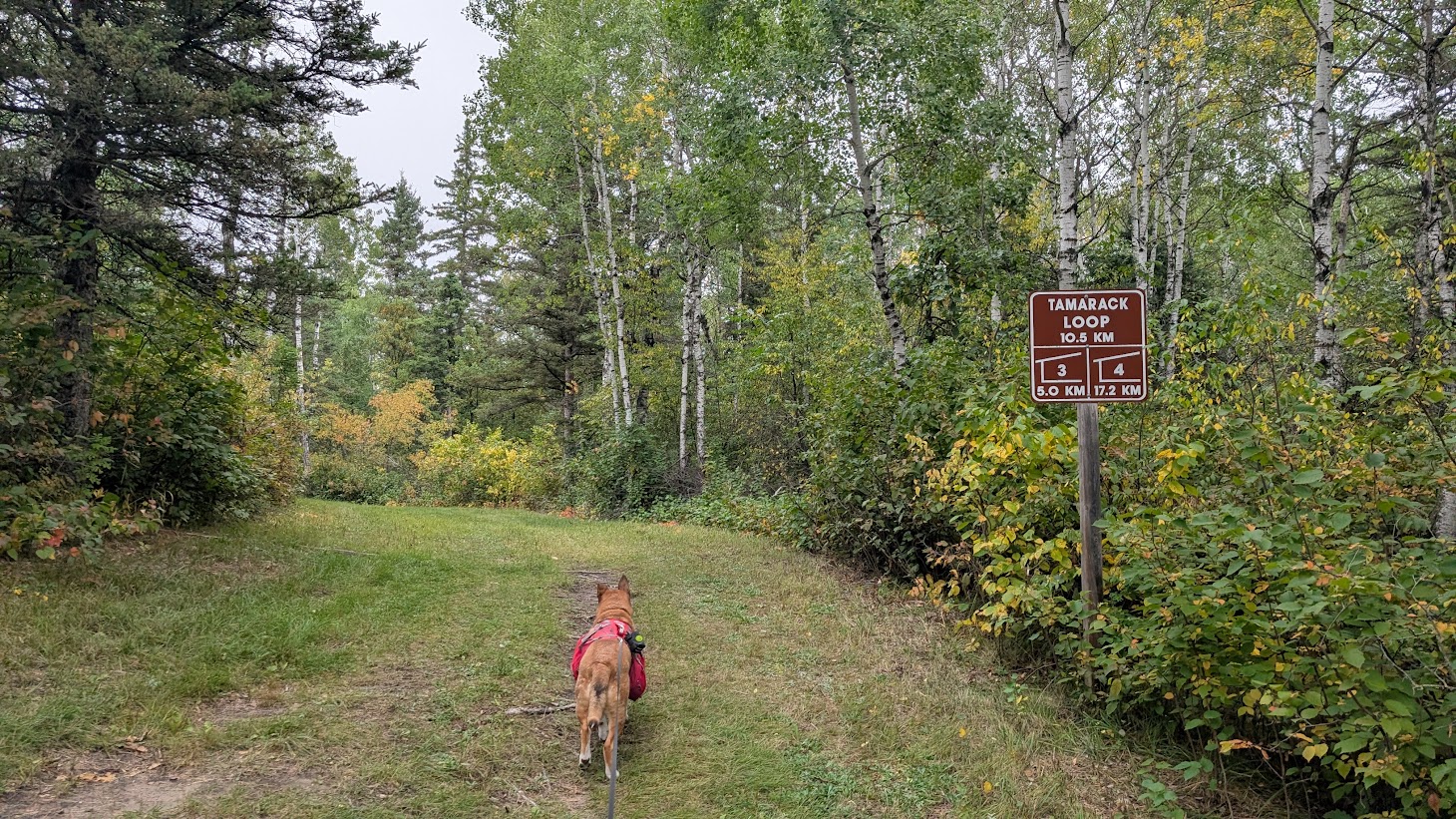
The wide and mowed Tamarack Loop trail.
Toward Cabin 3 (~7.5 km): Tree Tunnels, Fall Colors, and Wildlife
We didn’t stay long at Cabin 2 and continued down the trail. There were sandy patches here and there, but eventually we were led into tree tunnel after tree tunnel. This wasn’t an issue, since we appreciated the shade when temperatures rose. Bear scat soon became frequent, evidence that they had been eating berries in the area.
Since we went in the fall, the trail was surrounded by vibrant color. We enjoyed greens, yellows, oranges, and reds, with leaves gently falling to the ground in front of us. We spotted mushrooms and wildflowers along the way.
Before a large sandy hill we had to climb, we came across a creek running through a culvert. A beaver had built a dam both at the culvert and a little further upstream. This was the only water source between Cabin 2 and Cabin 3, but we recommend stocking up at Cabin 2 rather than drinking from the beaver pond. As we climbed the sandy hill, we saw beaver prints in the dirt and a freshly chewed stump from the resident.
We continued on, passing more bear scat and deer tracks along the way. What impressed us most was how easy the trail remained. The condition was consistent—well mowed and clear—and the difficulty never increased. Rolling hills broke up the terrain, but aside from the sandy climb by the creek, there were no steep sections. We stopped for a snack at a viewpoint bench and then carried on to finish the last few kilometers.
Watson resting at the viewpoint.
Arriving at Cabin 3
The trail pointed straight to the water pump, so we knew we had reached our destination when it came into view. Several tents were already set up nearby. As we explored, we found the outhouse, the cabin, and two picnic tables with firepits. Unfortunately, there are no bear storage lockers on these trails, and we even noticed bear scat near the outhouse. We used the garbage bins to get rid of food wrappers and stored our bear-proof food canisters inside the cabin.
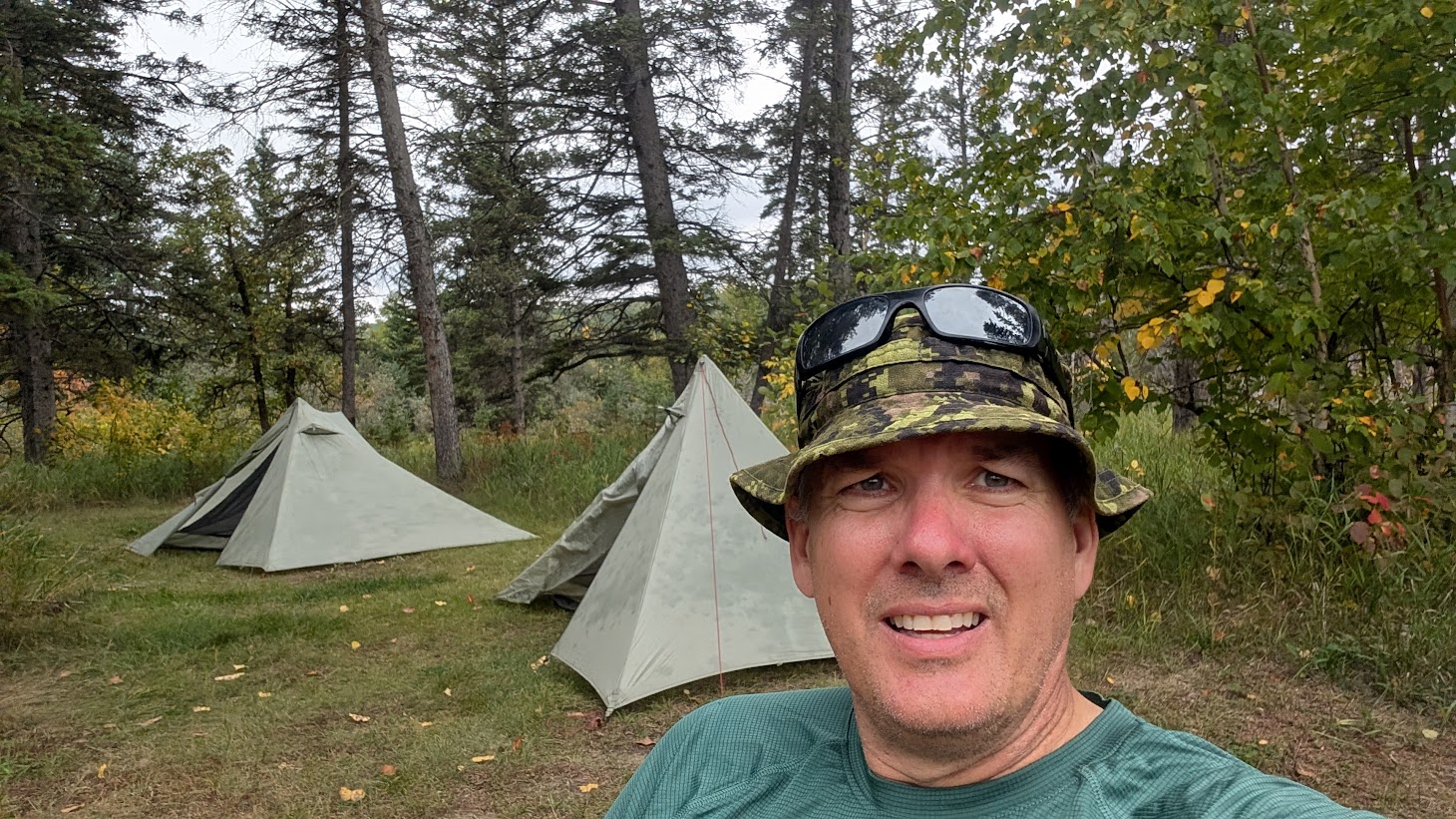
Since we were hiking with our dog Watson—and Cheryl wanted practice setting up her own gear for future solo hikes—we opted to bring two tents. Cheryl camped in the Durston X-Mid 2p with Watson, while Oliver camped in the Durston X-Mid 1p that he had used on the Arizona Trail.
Our tenting spot at Cabin 3.
Evening in Camp
After dinner, the students from the other tents returned from day-hiking the Newfoundland Loop, which we planned to hike the next day. They were on a school trip working toward their Duke of Edinburgh Award and had been practicing fire-starting with flint and steel. We shared fire starting tips before we finally turned in for the night.
Watson curled up happily on his sleeping mat, and we quickly fell asleep—thankfully with no bear visitors that we were aware of.
Epinette Creek Trail Conditions and Scenery
Trail conditions on the Epinette Creek Trail were excellent. The path was wide, with no concerns about packs snagging on branches or needing to climb over fallen trees. We even noted the lack of spiderwebs across the trail, likely because the path is so broad.
Since we hiked in the fall, the leaves were just beginning to change colour. A few were starting to fall, creating a beautiful seasonal backdrop. The trail was very well maintained, with few branches or roots underfoot that could trip you up. There were several scenic viewpoints to pause and enjoy a snack—though only one spot had a bench.
The scenery shifts often along this section, alternating between open spaces and denser vegetation. Even though the trail itself is easy, it never feels monotonous because there’s always something new to see in the plant life around you.
Cabin Amenities and Tips
Water: The pump at Cabin 3 was functional but noisy. If you’re an early riser, consider collecting water the night before to avoid disturbing others in the morning.
Outhouses: At Cabin 3, the outhouse had no hand sanitizer left, which isn’t unusual since it appeared to be the most used cabin of the four. If you want sanitizer, be sure to pack your own. Toilet paper wasn’t an issue, though we always bring extra just in case.
Firewood: We noticed very little firewood at Cabin 2, but we didn’t stay long enough to search thoroughly. Cabin 3, however, had plenty.
Final Thoughts on Epinette Creek Trail – Day 1
Day 1 on the Epinette Creek Trail made for a smooth and enjoyable start. The trail was wide, well-marked, and very well maintained. Campsites were clean and thoughtfully equipped with basic amenities. There was plenty of toilet paper, the water pumps worked, and we found enough firewood for a campfire. Having garbage and recycling bins available was an unexpected bonus, something you don’t often see in backcountry hiking. It was nice not to have to pack out every bit of trash.
We aren’t accustomed to such wide trails, as most of our hiking has been on narrow singletrack with some overgrowth. While we had expected this style of trail on the Mantario, wildfires had closed it this year. Even if it had been open, easing back into hiking after medical issues would have made us hesitate.
One surprise was the sheer amount of bear scat. We had originally left the bear spray at home, thinking it unnecessary this far south in Manitoba. After seeing fresh scat along the trail and later hearing from another hiker who had a stand-off with two bears by Cabin 4 earlier this year, we decided that bringing bear spray would be a good idea next time.
Day 1 Summary
Date: September 12, 2025
Distance: Trailhead to Cabin 3 – 9 km / 5.5 mi
Elevation Gain: 521 ft
Amenities:
Cabin 1: Pit toilet, warming cabin with wood stove, water pump, bear-proof garbage and recycling bins
Cabin 2: Pit toilet, warming cabin with wood stove, water pump, firepit, picnic tables, benches, bear-proof garbage and recycling bins
Cabin 3: Pit toilet, warming cabin with wood stove and sleeping loft, water pump, firepit, picnic tables, bear-proof garbage and recycling bins
Water Sources: One beaver-occupied creek; otherwise, only available at cabin water pumps
Wildlife: Deer tracks, beaver prints, and plentiful bear scat (especially between Cabins 2 and 3, and near Cabin 3’s outhouse)
Navigation: Wide, mowed trail with clear signage showing distances to the parking lot and next cabin
Best Time to Hike: Spring (before ticks) or fall (after ticks)
It is my hope to make my dream of hiking the Appalachian Trail in 2027 a reality. Up until now, I have always hiked with my husband, but in 2027 I want to hike the Appalachian Trail as a solo hiker. As long as I can arrange the time off of work, I will be hiking the Appalachian Trail in 2027.
In April 2025, my husband will be hiking the Arizona Trail as a solo hiker. We section hiked the Arizona Trail last year and enjoyed it. He wanted to do a hike that he could pull off this year with time off and something warm. I’m sure he’ll explain more about his reasons in a future blog post. He hasn’t expressed as much interest in doing the Appalachian Trail as I have.
I Want to Join Others On the Appalachian Trail in 2027
There are multiple vlogs each year from people who have hiked the trail. I thoroughly enjoy watching everyone’s story and journey as they have pushed their limits to reach Katahdin. Vlogging has become something that I enjoy doing on the trail, so when my turn comes to hike, I will be vlogging. It is such a great way to document your hike and revisit it later. It is also a great way to show other people, like me, what the trail offers. Every time I watch people on the trail, I get more and more excited about it.
How Am I Saving For The Appalachian Trail?
Why am I thinking about it so early? My planned start is still 2 years away. Well, it is going to be expensive to hike the Appalachian Trail. I am currently working through a budget as if I am going to spend 5.5 months on the trail. My rough estimate for savings in 2 years is $10,000. Some people would say that is about right. Some would say that’s too much. That is $10,000 CDN and I will need to consider what the exchange rate will be when I decide to go. I would like to save more than $10,000 so I have plenty of flexibility with bad weather days or even healing up from who knows what.
I found a plan to save $10,000 in 52 weeks and have started putting money away following this plan with a slight modification. When it wants me to save $150 in one week, I am stretching that amount over two weeks: $75 in week 1 and $75 in week 2. This allows me to extend the plan over 104 weeks and will have $10,000 by the end of February. If I end up with bonus money, I will throw it on there as well.
In a future post, I may share what my budget looks like. It is still a work in progress, but it might be helpful for someone.
Another Way to Fund My Appalachian Trail Hike
A few years ago, I also started writing. I have a pen name and write sweet romance novels & short stories. Think Hallmark movies. Right now, I have two available on Amazon and any sales generated from these will go my Appalachian Trail fund. I am also in the middle of writing another romance involving backpacking near a small town. I’m hoping to release a couple of novels that will not only fund my trip, but can help to bring in more while I am on trail. Every little bit will help.
If you enjoy books and you want to help my Appalachian Trail fund, you can find my books here:
I am going to be watching the 2025 and 2026 hikers and continue to capture data on the distances they hiked early on versus later mileage. I’ll definitely be checking what tenting sites look like around the shelters and make note of where I will want to stay. Already, I have downloaded the FarOut App with the Appalachian Trail route. (Yay for Black Friday sales!) I am a geek so I have been creating a spreadsheet with all of information I have gathered so far and, of course, my budget.
2027 might be seem far into the future, but there is so much planning involved that I am happy to have time to save and gather as much information as I can (even if some information will change between now and then.